How torque saves fuel
An ECU remap isn't just about horsepower. Extra low-end torque lets your engine do the same work with less throttle, fewer gear changes and lower rpm — that's where the fuel savings come from.
More torque = less pedal for the same acceleration. Injection duration drops, so fuel burn drops.
Higher torque earlier in the rev range keeps you in top gear on hills and overtakes — no downshifting.
Optimised injection timing and rail pressure means a more complete burn — less soot, less CO₂.
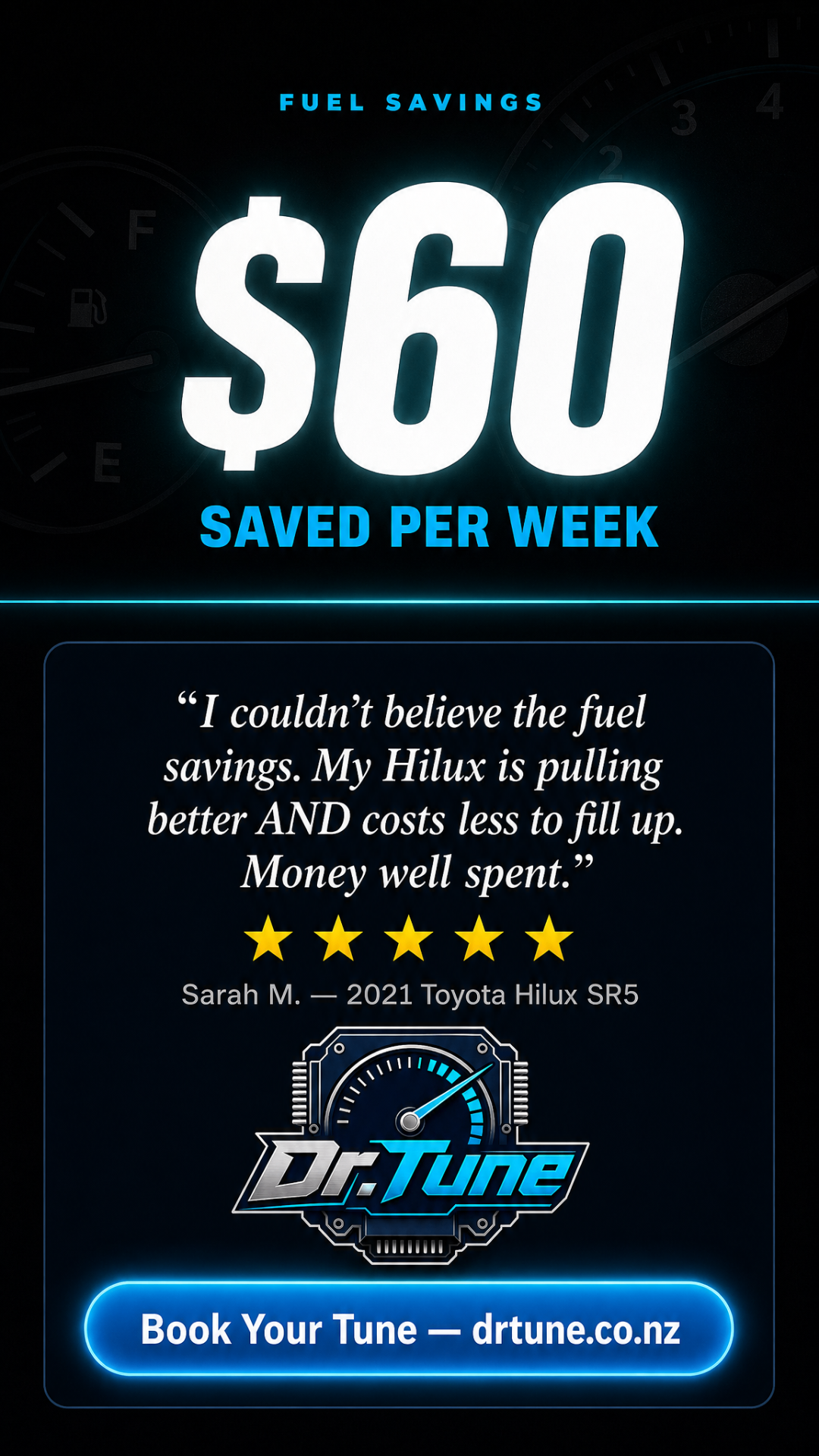
$60 saved per week — every week
Sarah's 2021 Hilux SR5 uses ~11.4% less diesel after her Stage 1 remap. That's roughly $3,120 back in her pocket every year, and her ute pulls harder than the day she bought it.
Fuel Savings & ROI Calculator
Enter your vehicle's fuel usage. We'll estimate the annual saving, CO₂ reduction and how many months until your remap pays for itself.
Diesel CO₂ factor ~2.68 kg/L, petrol ~2.31 kg/L. Estimated at typical NZ fuel prices.
Typical Smart Tuning results
| Vehicle | Stock | After remap | Fuel drop |
|---|---|---|---|
| Ford Ranger 2.0 BiTurbo | 9.4 L/100km | 8.0 L/100km | -15% |
| Toyota Hilux 2.8 GD-6 | 10.2 L/100km | 8.9 L/100km | -13% |
| VW Amarok V6 TDI | 10.8 L/100km | 9.5 L/100km | -12% |
| Isuzu D-Max 3.0 | 9.8 L/100km | 8.6 L/100km | -12% |
| Scania R500 | 36 L/100km | 31 L/100km | -14% |
| MAN TGX 480 | 34 L/100km | 29.5 L/100km | -13% |
| CAT 320D excavator | 17 L/hr | 14.8 L/hr | -13% |
Data based on Smart Tuning customer logs 2023-2026. Individual results vary with duty cycle and driver behaviour.